Hey everyone, it’s Jake from your go-to drilling and tapping center supplier, and today I’m breaking down one of the most common questions I get from shop managers, small fab owners, and even new aerospace prototypers: “How much floor space do I actually need for a drilling and tapping center?” I’ve been in this game for 12 years, so I’ve seen guys jam a machine into a corner only to regret it, and others blow out their budget on a space 3x bigger than they needed. Let’s cut through the fluff and get real—no corporate jargon, just what works. Drilling and tapping center
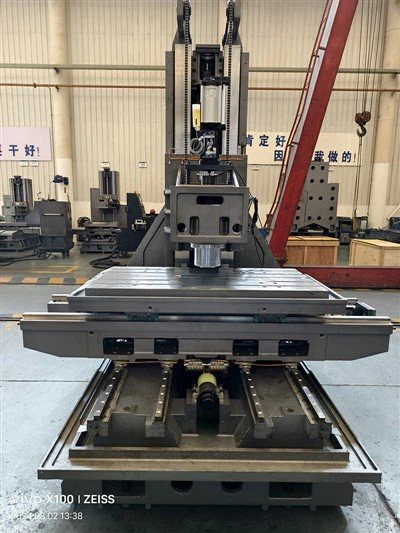
First off, let’s clarify what we’re talking about here. A drilling and tapping center isn’t a basic drill press you have in your garage. These are full CNC units, right? They move on X, Y, Z axes, have tool changers (usually 16 to 32 tools), and some even do milling too. The floor space isn’t just the size of the machine’s body—you’ve got to account for everything around it that makes it run. I’ve had a guy come to me saying he only has a 10×12 foot spot, and I had to explain that won’t cut it (pun so intended).
Let’s start with the machine’s physical footprint. Every good drilling and tapping center spec sheet will list this, usually something like 5ft long by 3ft wide for a compact 16-tool unit, up to 8ft long by 5ft wide for a larger 32-tool model that handles bigger workpieces. But wait— that’s just the machine itself. You need at least 2 to 3 feet of clearance on all sides, minimum. Why? Because you’ve got to load and unload parts without banging the machine, you need space to pull tools from the changer if one gets stuck, and let’s be real—you don’t want to be crammed in so tight you knock over a coolant jug every time you walk past. I once had a customer skip that clearance for a tiny shop, and they ended up scratching a $500 aluminum billet because they couldn’t swing the part out. Oops.
Then there’s the auxiliary stuff. Coolant tanks, chiller units, control panels—wait, some controls are mounted on the machine, but larger units have standalone chillers that sit on the floor. For a mid-sized unit, that’s another 2×3 foot spot right next to the machine. If you’ve got a parts washer or a chip conveyor (which you absolutely need—you don’t want metal shavings piling up), that adds another 3 to 4 feet along the side. Pro tip: always leave a little extra space for a small workbench for prepping parts, checking gauges, or stashing tools. I never understood why guys skimp on that bench space—you end up dumping parts on the floor or using your lunchbox as a stand.
Wait, what about overhead clearance? People forget this all the time. The machine’s Z-axis travels, right? A standard drilling and tapping center has a Z-travel of 12 to 20 inches, so you need at least 2 feet of overhead space above the spindle when it’s all the way up. If you’ve got a ceiling with exposed ducts or lighting fixtures too low, that’s a problem. I had a customer in a old warehouse where the beams were too close—they had to raise the machine’s mounting pad, which cost them more than adding a foot of floor space. Lesson learned: measure from your floor to the lowest overhead thing before you buy, not after.
Now let’s break this down by machine size, because not every drilling and tapping center is the same. We do three main lines here, so I can speak from experience: compact, mid-range, and heavy-duty.
Our compact line—great for small shops, prototyping, or low-volume runs. That’s a 16-tool unit that handles parts up to 12 inches square. Total floor space needed? Typically 10ft long by 8ft wide. Wait, let’s math that out: 5ft machine, plus 3ft on each side (2×3=6), so 5+6=11? Yeah, I round down a little for tight spots, but never go less than 9×7. This fits in most small shop bays, even if you’re sharing space with another machine. We just sold three of these to a guy who used to run his drill press on his kitchen table (don’t do that, by the way) and now has a spot in his 20×30 garage workshop. He measured, planned, and it worked perfect.
Next, mid-range—our bestseller, handles parts up to 24 inches square, 24-tool changer, does light milling too. This is what most small to mid-sized fab shops, automotive part shops, and even small aerospace prototypers go for. Total floor space here? 15ft long by 10ft wide. That’s enough for the machine, chiller, chip conveyor, a small workbench, and still has room to move around. I always tell customers: if you’re setting up a standalone drilling and tapping center, don’t go smaller than 14×9, and if you can swing 15×10, that’s way less headache. The last thing you want is to have to rearrange your entire shop a month after installation because you crammed it in too tight.
Then our heavy-duty line—for guys running production, parts up to 48 inches square, 32-tool changer, can handle thicker materials like steel. That’s a bigger machine, so total floor space jumps to 20ft long by 12ft wide. You also need a little extra because you might be loading bigger parts, maybe even a pallet system later. I had a customer doing brackets for commercial trucks—he had two of these set up side by side, so he left a 5ft gap between them for a forklift to move pallets. That added to his total space, but it’s production, so downtime isn’t an option. He told me cutting that gap would’ve meant 15 minutes of extra time per pallet, which added up to thousands a month.
Now, what factors change this? It’s not one-size-fits-all, right? Let’s talk about modifications. If you’re adding a parts loader/unloader, that’s extra 4 to 6 feet along the side. If you’re using mist collectors or other dust extraction gear, that’s another 2 to 3 feet. And if you’re working with really large or heavy parts—like 4ft steel plates—you need to add space specifically for moving those parts. Don’t try to swing a 50lb steel plate around a machine that’s in a 3ft gap. I’ve seen parts drop and dent, people get injured, all because they skipped that extra space.
Also, shop layout matters a lot. If you’re putting your drilling and tapping center along a wall, you don’t need as much space on the back side—maybe 2ft instead of 3, since the wall is there. If it’s in the middle of the shop, surrounded by other machines, you need clearance on all sides for safety and access for maintenance. Speaking of maintenance—you need space to pull the tool changer, replace parts, or fix a coolant leak. If you can’t get a wrench in there, your machine is gonna be down longer than it needs to be. I once had a customer whose machine was so crammed he had to unbolt the tool changer every time it needed a new bearing. That took 2 hours instead of 20 minutes—total waste.
Wait, what about small shops or home setups? A lot of our customers are hobbyists or guys just starting out, so they don’t have giant warehouses. The compact line fits great in a 10×10 workshop, but even that works if you plan it right. Just make sure you’re not storing anything in the clearance space around the machine—shavings, parts, tools, whatever. That’s a fire hazard too, not just a space issue. I had a hobbyist who stacked aluminum sheets next to his drilling and tapping center, and a stray spark from a tool change caught them on fire. Luckily no one got hurt, but he had to replace his machine and his workshop. Lesson: clearance space is for clearance, not storage.
Another thing: power and utilities. Don’t forget that the space you pick has to have 220V power (most drilling and tapping centers run on 3-phase, even the compact ones—sorry, single-phase isn’t enough for good performance) and a water supply for the coolant. You don’t want to set up the machine in a spot with no power, so you have to run extension cords. That’s a tripping hazard and it’s bad for the machine’s performance. Factor in the space needed for conduit or a disconnect switch too—usually a foot or two along the wall near the machine.
Now, let’s get real about mistakes I see all the time. First, buying the machine first then finding space. Don’t do that. Measure your available space, plan where everything goes, then pick the machine that fits. I had a customer do this—bought a mid-range unit, measured his shop, and realized he only had a 12×8 spot. He had to sell the mid-range and downgrade to the compact, which cost him time and money. Second, skipping overhead clearance. I mentioned this earlier, but it’s worth repeating. A friend of mine runs a machine shop, and he had a machine that hit a duct because he didn’t measure overhead. He had to lower the ceiling a foot, which was a huge pain. Third, not leaving extra space for growth. Even if you’re a small shop now, you might add another machine, upgrade to a pallet system, or take on bigger jobs in a year. Don’t set yourself up to have to rearrange everything a year from now. Add 10 to 15% extra space to your initial plan.
So, to wrap this up, here’s the quick breakdown you can take with you today:
- Compact drilling and tapping center: 9-10ft L x 7-8ft W
- Mid-range drilling and tapping center (bestseller): 14-15ft L x 9-10ft W
- Heavy-duty production drilling and tapping center: 19-20ft L x 11-12ft W
Always add 2-3ft clearance on all sides, plus space for aux gear, power, and maintenance.
At the end of the day, floor space for a drilling and tapping center isn’t just about fitting the machine—it’s about keeping it running smoothly, keeping you safe, and leaving room to grow. If you’re unsure about your specific shop space, don’t guess. Hit me up, we can walk through your layout, answer questions about machine specs, and help you pick the right unit and space for your needs.

Don’t forget, we’ve got demos, financing options, and service teams that will get your machine up and running in no time. No need to stress over the space or the specs—we’ve done this a thousand times. Reach out whenever you’re ready to chat details, or if you want to check out our line in person. We’re here to help you make the right call for your shop.
XYZ Linear Way Vertical Machining Center References:
- Haas Automation Inc. (2023). CNC Machine Footprint and Installation Requirements. Retrieved from manufacturer technical documentation for vertical machining centers (drilling and tapping center category)
- Machinery’s Handbook (31st ed.). (2020). Machine Shop Layout and Workspace Planning. Industrial Press Inc.
- American Machine Tools Association. (2022). Best Practices for CNC Machine Installation and Floor Space Allocation. Industry safety and efficiency guidelines for drilling and tapping centers.
Smartech Machinery & Equipment Co., Ltd.
As one of the most professional tapping center machine manufacturers and suppliers in China, we also support customized service. Please rest assured to buy bulk tapping center machine made in China here from our factory. Contact us for more details.
Address: Room 2832, Changping Commercial Mansion, Shihua Road, Futian Free Trade Zone, Shenzhen, China
E-mail: smartech@smartechcnc.cn
WebSite: https://www.smartech-cnc.com/
